

AI short video creator review revealing 7 real pros, cons, pricing & results. See if this AI short video creator is worth it in 2025.
Introduction – Why Short Videos Dominate Online Attention
Short-form content has completely reshaped how people consume information, products, and entertainment online. Platforms like YouTube Shorts, Instagram Reels, and TikTok are no longer optional—they are the primary traffic sources for brands and creators. This is exactly why tools positioned as an AI short video creator are exploding in demand. Businesses want speed, creators want consistency, and beginners want simplicity.
The promise behind an AI short video creator is straightforward: remove the barriers that stop people from posting daily content. No camera anxiety, no editing overwhelm, no creative burnout. Instead of spending hours brainstorming, scripting, and editing, users want automation that still looks natural and platform-friendly. That’s where modern AI solutions step in.
What makes this space competitive is not just automation, but outcome. People don’t want videos—they want views, clicks, and conversions. A well-built AI short video creator claims to handle visuals, captions, timing, and formatting in a way that aligns with current platform behavior. Whether that promise holds up is what this review-based article is designed to unpack, logically and without hype.
Who’s Behind the Creation of This Software?
Understanding who builds a tool matters more than most buyers realize. In the AI space, many products are rushed clones with aggressive marketing but weak long-term support. When evaluating faceless video creation software, the creators’ intent, experience, and business model become critical trust factors.
This software is positioned as a commercial-friendly, beginner-safe platform rather than a hobby tool. That usually indicates a development team focused on marketers, freelancers, and agencies—people who need reliability and scale. Faceless video creation software doesn’t succeed unless the backend systems (rendering, templates, voices, exports) are stable under volume usage.
Another important signal is how the creators handle licensing, updates, and training. Serious faceless video creation software typically includes documentation, onboarding tutorials, and customer support—because the target audience isn’t technical. While marketing pages highlight features, the real test is whether the creators designed this platform to survive beyond a launch cycle. That’s why reviewing ownership intent is just as important as reviewing features.

Key Details of the Product at a Glance
Before diving deep, it helps to clearly define what this platform actually offers on paper. At its core, this is marketed as an AI reels and shorts generator designed for speed, scale, and monetization. The product claims to convert keywords or images into ready-to-post short videos using AI-generated scripts, visuals, voiceovers, captions, and music.
The AI reels and shorts generator focuses heavily on automation rather than creative control. Users are guided through preset styles such as product promos, memes, motivational reels, catalog demos, and avatar-based videos. This matters because most buyers are not filmmakers—they are marketers or beginners who value efficiency over perfection.
Other key details include multi-language support, voice libraries, export formats, and commercial usage rights. An AI reels and shorts generator becomes valuable only if it removes dependency on external tools. That’s why built-in captions, hashtag generation, and platform-ready exports are emphasized. These details help determine whether this is a standalone solution or just another partial tool that still requires extra software.
What Is This Product Really Designed To Do?
Stripped of marketing language, this platform is an AI video tools for social media marketing solution focused on volume and consistency. It is not built for cinematic storytelling or custom branding from scratch. Instead, it’s designed to help users publish frequently without friction.
AI video tools for social media marketing prioritize speed, repeatability, and trend alignment. The idea is simple: more posts increase reach, and reach creates monetization opportunities. This tool leans into that philosophy by automating the most time-consuming parts—writing, editing, formatting, and exporting.
Another important angle is positioning. AI video tools for social media marketing are increasingly used not just by creators, but by freelancers selling content as a service. That explains the emphasis on commercial licenses, client-ready outputs, and fast turnaround. If you view this product as a creative studio replacement, expectations will be misaligned. If you view it as a scalable content engine, the positioning makes logical sense.

Product Review – Key Features Breakdown
At a feature level, this platform positions itself as an AI short video creator built for output, not perfection. The core strength is automation depth. Users aren’t just generating visuals—they’re getting scripts, voiceovers, captions, music, and formatting bundled into a single workflow. That’s critical, because most tools fail by handling only one or two steps and forcing users to stitch everything together elsewhere.
Another notable feature is style diversity. Instead of asking users to design from scratch, the AI short video creator relies on preset content formats like promos, memes, reels, avatar explainers, and catalog demos. This reduces decision fatigue, which is one of the biggest blockers for beginners. You choose a style, enter a keyword or image, and the system handles the rest.
Speed is the second major differentiator. Rendering times are positioned as near-instant, which matters for anyone posting daily or managing client work. Add in caption and hashtag automation, and the feature set clearly targets consistency at scale. This isn’t a creative playground—it’s a production engine designed to remove friction and push volume without technical skill.
Step-by-Step Operational Process Explained
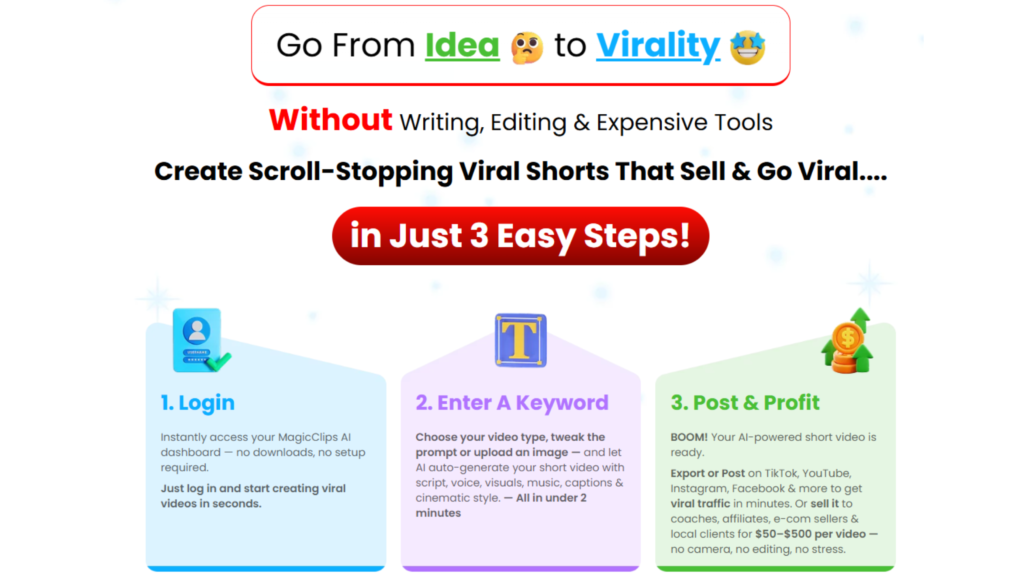
The operational flow is intentionally simple, which aligns with the promise of faceless video creation software. Step one is access—no installs, no setup, no local rendering. This removes device dependency and allows users to work from any browser. That alone lowers the entry barrier for non-technical users.
Step two is input. Users either enter a keyword, select a predefined content style, or upload an image. This is where faceless video creation software becomes powerful: you don’t need to appear on camera, record audio, or write scripts. The AI assembles scenes, voiceovers, captions, and visuals automatically based on the selected format.
Step three is output. Videos are exported in platform-ready formats or posted directly. The goal here is speed to publish, not endless tweaking. Faceless video creation software works best when it encourages momentum, not perfectionism. By minimizing choices and emphasizing “create → post,” the workflow supports daily publishing and client delivery without burnout or delays.
How Does It Work Behind the Scenes?
Under the hood, this platform operates as an AI reels and shorts generator using modular automation. Instead of generating a single long video, it assembles short scenes optimized for retention—fast hooks, visual transitions, subtitles, and pacing aligned with short-form algorithms.
The AI reels and shorts generator first interprets intent from the keyword or image. It then selects a compatible template, matches it with visuals, assigns a voice style, and generates captions that fit the tone. This layered approach matters because short-form content fails when any one element feels off—especially pacing or subtitles.
Another important aspect is repeatability. An AI reels and shorts generator isn’t about creating one perfect video; it’s about producing many acceptable videos consistently. That’s why customization exists, but is optional. Advanced users can tweak voices, captions, or visuals, while beginners can rely entirely on defaults. The system is optimized for scale, not experimentation, which explains both its strengths and its limitations.
Who Actually Needs This Product?
This tool is best suited for users who see content as a growth mechanism, not an art project. Specifically, AI video tools for social media marketing appeal to people who value speed, reach, and monetization over creative expression. That includes affiliates, freelancers, agencies, and faceless creators.
Beginners benefit because AI video tools for social media marketing eliminate the learning curve. No scripting knowledge, no editing skills, no camera confidence required. Freelancers benefit because turnaround time drops dramatically, making it possible to sell video services profitably at scale. Agencies benefit because they can standardize outputs across niches without hiring editors.
Who doesn’t need it? Perfectionists, filmmakers, or brand designers who want frame-level control. AI video tools for social media marketing are designed for consistency and volume, not bespoke storytelling. If your goal is daily posting, client delivery, or testing multiple niches quickly, this category of tool makes sense. If your goal is cinematic branding, it doesn’t.


What Makes This System Worth Trying?
What makes this platform worth testing isn’t novelty—it’s alignment with how content is actually consumed today. An effective AI short video creator doesn’t need to be perfect; it needs to be fast, consistent, and algorithm-friendly. This system is built around that reality rather than creative idealism.
The real value comes from removing resistance. Most people fail at short-form content not because they lack ideas, but because production is exhausting. An AI short video creator reduces that friction by automating scripting, visuals, voiceovers, and captions in one flow. That’s what enables daily posting, which is the real growth lever on social platforms.
Another factor is risk-to-reward ratio. With a low entry price and no recurring fees during launch, testing the system doesn’t require long-term commitment. For affiliates, freelancers, or beginners, that matters. If one or two videos convert—or one client sale lands—the tool pays for itself. That practicality, not hype, is what makes it worth trying for people focused on output and results rather than perfection.
How Much Does the Product Cost? (Including OTOs Details)
Pricing is positioned as a one-time entry rather than a subscription, which immediately differentiates it from most faceless video creation software on the market. The front-end cost is low enough to feel like a test purchase rather than a financial decision, especially for beginners.
However, the real cost structure includes optional upgrades. These OTOs typically unlock higher limits, faster rendering, additional templates, commercial scaling features, or expanded asset libraries. That’s standard in faceless video creation software funnels, but buyers should be aware that the front-end plan may come with usage caps such as credits or resolution limits.
The upside is flexibility. You can start cheap, validate results, and upgrade only if the tool fits your workflow. The downside is expectation management—“lifetime” usually refers to the current version’s support window, not infinite usage without limits. Understanding this pricing structure upfront helps users avoid disappointment and evaluate the platform based on actual usage needs rather than headline pricing alone.
Why Should You Choose This Product Over Others?
Choosing between tools in this space comes down to focus. An AI reels and shorts generator should either give you deep creative control or maximum speed. This product clearly chooses speed—and that’s not a flaw if it matches your goal.
Compared to multi-tool setups, this AI reels and shorts generator reduces friction by keeping everything under one roof. You’re not jumping between script tools, voice platforms, editors, and caption generators. That integration saves time and mental energy, which matters more than feature depth for most users.
Another differentiator is commercial readiness. The inclusion of licensing, templates, and fast output makes it easier to sell videos as a service. Many competitors are creator-first but not client-ready. This one is structured for monetization from day one. If your goal is content volume, testing niches, or client delivery—not creative experimentation—this product makes logical sense compared to heavier, more complex alternatives.
Bonus Breakdown – What’s Actually Useful?
Bonuses often inflate perceived value, but not all bonuses are equal. In this case, the bonuses are clearly aligned with AI video tools for social media marketing, not generic motivation content. Training on client acquisition, agency setup, and monetization directly complements the core tool.
The most practical bonuses are those focused on implementation—how to sell videos, how to package services, and how to use short-form content for funnels. AI video tools for social media marketing only work when paired with strategy. Without that, users end up creating content with no monetization path.
Some bonuses may feel redundant for experienced marketers, but for beginners they reduce confusion and shorten the trial-and-error phase. The real value isn’t the dollar amount attached—it’s whether the bonus helps you move from “tool owner” to “tool user.” In this case, the bonus stack is functional, not random, which increases the odds of actual usage.

Pros and Cons – A Clear-Eyed Breakdown
No tool is perfect, and pretending otherwise kills credibility. Starting with the positives, the biggest advantage of this AI short video creator is speed. The ability to generate publish-ready short videos without scripting, editing, or recording removes the biggest barrier most people face. It’s also beginner-friendly, which matters because complexity is why many tools go unused.
Another strong pro is consistency. An AI short video creator makes it realistically possible to post daily, test niches, or fulfill client orders without burnout. Commercial usage rights and multi-language support also expand monetization potential beyond personal content creation.
On the downside, customization depth is limited. This is not a cinematic editor or branding-first platform. Users who want frame-by-frame control or unique visual identity may feel constrained. Also, usage limits via credits mean heavy users may eventually need upgrades. In short, the pros favor speed and scale, while the cons mostly affect advanced creators seeking full creative control.
Conclusion – Is This Tool Worth Your Time?
This platform succeeds or fails based on expectations. As faceless video creation software, it is designed to remove friction—not replace creative professionals. If your goal is volume, consistency, and monetization, it delivers on that promise logically.
Faceless video creation software works best when users focus on outcomes instead of perfection. This tool enables rapid testing, daily posting, and client delivery without technical overhead. That alone puts it ahead of many bloated, expensive alternatives.
However, it’s not a magic button. Results still depend on niche choice, posting consistency, and understanding audience behavior. Used correctly, it’s a leverage tool—not a shortcut. If you approach it as a scalable content engine rather than a creative studio, the value proposition makes sense.
Can This Tool Really Help You Grow Faster in 2025?
Growth in 2025 is no longer about posting occasionally—it’s about consistency, speed, and relevance. That’s where an AI short video creator becomes a practical advantage instead of a shiny toy. Social platforms now reward creators who publish frequently and stay aligned with trending formats. Doing that manually burns time and energy fast, which is why most people quit before seeing results.
An AI short video creator helps solve the volume problem. Instead of spending hours on one piece of content, users can produce multiple short videos quickly and test what works. This matters because growth today is data-driven. You don’t guess—you publish, observe performance, and double down on what gets traction.
However, faster growth still depends on smart usage. Tools don’t replace strategy. Niches, hooks, captions, and posting schedules still matter. What the tool does is remove friction so execution becomes easy. When execution is easy, consistency improves. And when consistency improves, growth becomes predictable. Used correctly, this type of system doesn’t guarantee success—but it dramatically increases the odds by keeping you active instead of stuck.
FAQs – Straight Answers to Common Questions
Is this beginner-friendly?
Yes. This AI reels and shorts generator is built for users with no editing or scripting experience.
Do I need to show my face or record my voice?
No. The AI reels and shorts generator supports fully faceless videos using AI voices and visuals.
Can I use this for client work?
Yes, commercial licensing is included, making it suitable for freelancers and agencies.
Are there monthly fees?
The front-end offer is one-time, but usage limits may require upgrades for heavy users.
Will this guarantee views or income?
No tool can guarantee results. This AI video tools for social media marketing platform provides speed and automation—not outcomes.
Is it better than hiring editors?
For volume and speed, yes. For custom branding, no.

Hashtags
#AIShortVideoCreator
#AIShortVideos
#ShortVideoCreator
#AIContentCreation #VideoAutomation #FacelessContent
#FacelessVideo
#NoFaceContent
#ContentAutomation
#AIContentTools #ReelsCreator
#ShortsGenerator
#AIReels
#YouTubeShortsCreator
#InstagramReelsTool #SocialMediaMarketingTools
#AIMarketingTools
#ContentMarketingAutomation
#VideoMarketingAI
#DigitalMarketingTools #AIForCreators
#AIForMarketers
#ShortFormVideoMarketing
Okay, megafishingvn looks like a blast! Who doesn’t love shooting fish for prizes? The graphics are pretty good too. Going to give this a whirl! Check it out megafishingvn.